Textual description of firstImageUrl

Edouard Vuillard | Young woman at the wind, 1899

Édouard Vuillard, in full Jean-Édouard Vuillard, (born November 11, 1868, Cuiseaux, France - died June 21, 1940, La Baule), French painter, printmaker, and decorator who was a member of the Nabis group of painters in the 1890s.
He is particularly known for his depictions of intimate interior scenes.
Vuillard studied art from 1886-1888 at the Académie Julian and the École des Beaux-Arts in Paris.
In 1889 he joined a group of art students that included Maurice Denis, Pierre Bonnard, Paul Sérusier, Ker-Xavier Roussel, and Félix Vallotton.
They called themselves the Nabis (Hebrew for “Prophets”), and they drew their inspiration from the Synthetist paintings of Paul Gauguin’s Pont-Aven period.


Textual description of firstImageUrl

Aime-Nicolas Morot | Le bon Samaritain, 1880

Author: Aimé-Nicolas Morot (French painter, 1850-1913);
Title: The Good Samaritan;
Medium: oil on canvas;
Dimensions: Height: 268.5 cm - Width: 198 cm;
Current location: Musée du Petit Palais, Paris.

Born into a modest, actively Republican family, Aimé Morot pursued an exemplary career after receiving an academic training in the studio of Alexandre Cabanel.
Winner of the Prix de Rome in 1873, he used his stay at the Medici Villa as an opportunity to explore the Roman countryside on horseback.


Textual description of firstImageUrl

Edgar Degas | Conversation, 1882-1885

During the mid-1880s, Degas repeatedly explored the motif of two or three women leaning on a wooden railing - at the racetrack, on a pleasure boat, or before a landscape - absorbed in casual conversation..
"Degas was clearly intrigued by the visual possibilities of this moment of female intimacy", Jill DeVonyar and Richard Kendall have written, "making half a dozen variants of the composition with a range of outfits, headgear, and backgrounds" (op. cit., 2007, p. 66).


Textual description of firstImageUrl

Renoir | Port de Marseille, le Fort Saint-Jean, 1906


In the early 1880s Pierre-Auguste Renoir made his first forays abroad; he had previously traveled no further from Paris than Normandy. The years of 1881-1884 however saw Renoir in a variety of disparate locations including Algeria, Italy and the French Riviera.
It was on these journeys that he stepped away from rendering purely figure-based compositions, rather creating an interesting series of landscapes to record his new surroundings.
There is no doubt that these travels deeply affected Renoir and his art, and indeed he would return repeatedly to the South of France, eventually choosing to settle permanently in Cagnes-sur-Mer in the early 1900s.

Textual description of firstImageUrl

Guido Reni(?) | Portrait of Beatrice Cenci, 1599

Author: Guido Reni (Italian Baroque painter, 1575-1642)
Medium: Oil canvas
Dimensions: 64,5 x 49 cm
Current location: Palazzo Barberini, Rome

A long historical tradition has identified Beatrice Cenci in this portrait.
The young parricide, who was processed and beheaded in Rome in 1599, is immortalized in prison by Guido Reni a few instants before being killed.


Textual description of firstImageUrl

Berthe Morisot (French, 1841-1895)

Berthe Marie Pauline Morisot (January 14, 1841 - March 2, 1895) was a painter and a member of the circle of painters in Paris who became known as the Impressionists.
She was described by Gustave Geffroy in 1894 as one of "les trois grandes dames" of Impressionism alongside Marie Bracquemond and Mary Cassatt.


Textual description of firstImageUrl

Peter Paul Rubens | Study of Two Heads, 1609

Artist: Peter Paul Rubens (Flemish Baroque Era painter, 1577-1640)
Title: Study of Two Heads
Date: ca. 1609
Medium: oil on panel
Dimensions: Height: 69.9 cm (27.5 in); Width: 52.1 cm (20.5 in)
Current location: Metropolitan Museum of Art.

Rubens painted studies of heads after live models and artistic sources, creating a cast of characters that served in turn as models for figures in religious and mythological works.


Textual description of firstImageUrl

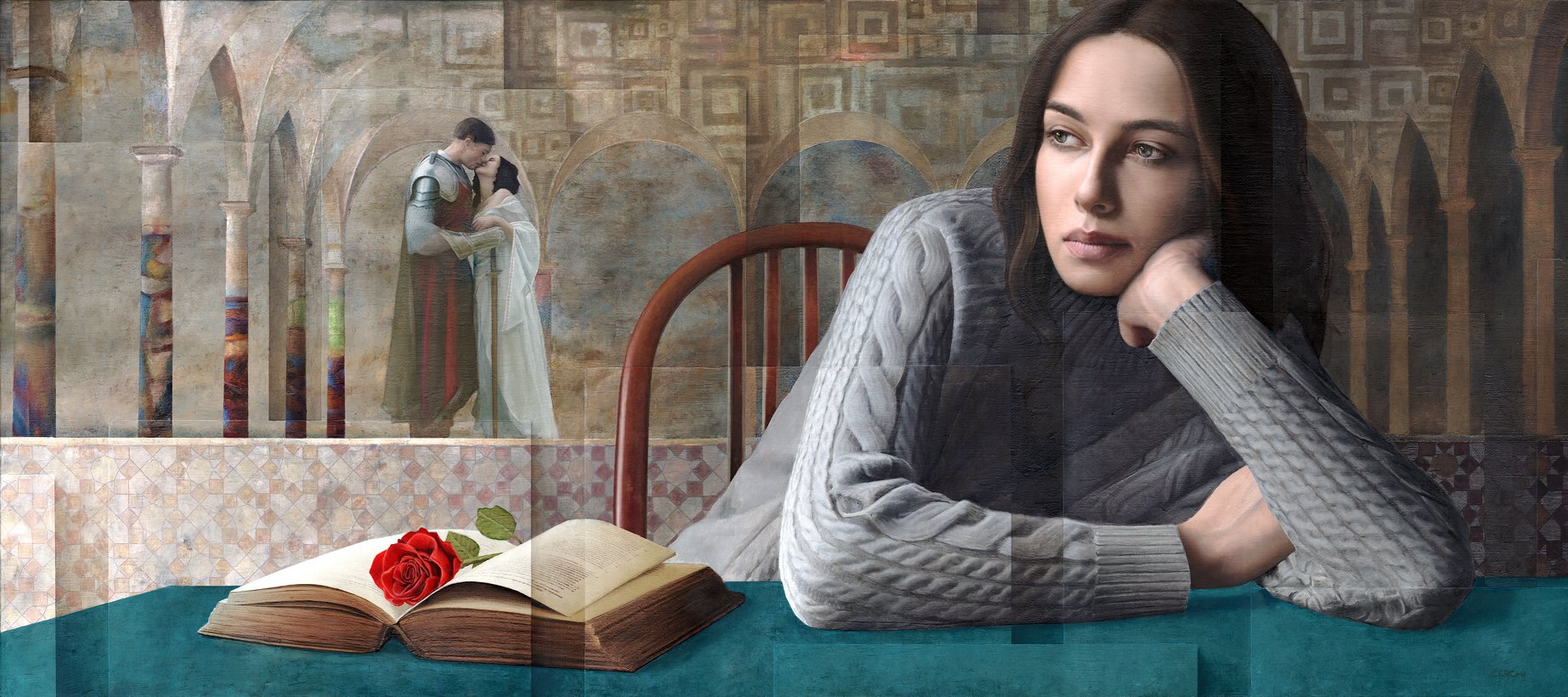
Sergio Cerchi (1957-2026)

Sergio Cerchi è nato a Firenze, città in cui ha vissuto e lavorato ed è venuto a mancare il 17.07.2026.
Le figure e le geometrie compongono la sua visione del reale, contrassegnata da una spinta etica che esprime valori non solo artistici, ma filosofici, storici e psicosociali.
Dai primi lavori pittorici con paesaggi e vedute, si è evoluto verso evocazioni "cubiste" e rielaborazioni del proprio vissuto, che hanno radicalmente mutato l' impianto materico e coloristico.
Soggetti e sfondi si moltiplicano nella sua pittura come su di un pentagramma musicale, sfumando orizzonti piani e volumi, in cui figure e particolari emergono leggibili e composti in modo affatto originale.
Cromie di colori ad olio, dalle calde tonalità' di rossi carminio, mescolati a sfumature ocra, a verdi antichi e blu con sapienti ombreggiature di grigi luminosi, danno corpo ad elementi petrosi, scultorei, emblematici delle materie e sostanze dei più grandi maestri dell'arte dai Primitivi al Rinascimento, di cui si nutre appunto la poetica e la pittura di Sergio Cerchi.


Textual description of firstImageUrl

Édouard Manet | The Grand Canal, Venice (Blue Venice) 1874

French painter Édouard Manet (1832-1883) visited the Grand Canal Venice in September 1875 with his friend and fellow painter from outside the Impressionist circle James Tissot, who had settled in London after the Franco-Prussian war of 1870-71.
Although the watery splendour of Venice has inspired many great artists, Manet found it hard to settle, but in spite of this he managed to paint one of his most dashingly Impressionist art works.

Edouard Manet | Venice-The Grand Canal (Blue Venice), 1874 | Collections of the Shelburne Museum, Vermont