Visualizzazione post con etichetta Fauve Art. Mostra tutti i post
Textual description of firstImageUrl

David Burliuk | Il padre del Futurismo russo

David Davidovich Burliuk /Дави́д Дави́дович Бурлю́к (1882-1967) è stato uno scrittore, pittore, giornalista, illustratore di libri, futurista e neo-primitivista ucraino, associato al movimento futurista russo. Burljuk è spesso descritto come "Il padre del futurismo russo".
David Burljuk nacque a Char’kov 1882 da una famiglia della classe privilegiata russa. Sua moglie fu istruita con i rampolli dello zar. Nel 1898 frequentò le scuole d’arte di Kazan e poi di Odessa e Mosca.
Nel 1902 si recò a Monaco per studiare presso Azbé, W. Diez e Archipov e nel 1904 frequentò a Parigi lo studio di Cormon.
I suoi primi lavori si rifecero all'arte Fauve "violenti nei colori e dalla verniciata greve" e furono esposti alla mostra del "Blaue Reiter" di Monaco.
Tornato a Mosca nel 1907 entrò in rapporto con gli artisti delle avanguardie ed in particolare strinse amicizia con Larionov e Goncarova.
L’influenza di costoro lo spinsero verso il Primitivismo il cui contributo è stato sovente trascurato a favore del più noto intervento sulla scena letteraria Cubo-Futurista.


Read More

David Burliuk | Il padre del Futurismo russo

David Davidovich Burliuk /Дави́д Дави́дович Бурлю́к (1882-1967) è stato uno scrittore, pittore, giornalista, illustratore di libri, futurista e neo-primitivista ucraino, associato al movimento futurista russo. Burljuk è spesso descritto come "Il padre del futurismo russo".
David Burljuk nacque a Char’kov 1882 da una famiglia della classe privilegiata russa. Sua moglie fu istruita con i rampolli dello zar. Nel 1898 frequentò le scuole d’arte di Kazan e poi di Odessa e Mosca.
Nel 1902 si recò a Monaco per studiare presso Azbé, W. Diez e Archipov e nel 1904 frequentò a Parigi lo studio di Cormon.
I suoi primi lavori si rifecero all'arte Fauve "violenti nei colori e dalla verniciata greve" e furono esposti alla mostra del "Blaue Reiter" di Monaco.
Tornato a Mosca nel 1907 entrò in rapporto con gli artisti delle avanguardie ed in particolare strinse amicizia con Larionov e Goncarova.
L’influenza di costoro lo spinsero verso il Primitivismo il cui contributo è stato sovente trascurato a favore del più noto intervento sulla scena letteraria Cubo-Futurista.


Textual description of firstImageUrl

Henri Matisse | La Tecnica pittorica


Henri-Émile-Benoît Matisse è uno dei più noti artisti del XX secolo, esponente di maggior spicco della corrente artistica dei Fauves.
Matisse usava partire dalla raffigurazione della realtà, trasformandola poi in forme semplificate ed appiattite attraverso l'accostamento di colori primari e secondari puri, accesi, luminosi, privi ormai di riferimento alla descrizione naturale.
La sua attività pittorica si svolse per decenni, nel suo quieto ambiente familiare, lontano dai clamori della vita mondana.
Svolse la sua ricerca portando il suo stile ad un affinamento progressivo che toccò le soglie dell'astrattismo, al quale si avvicinò soprattutto con la tecnica del collage su carta, con figure semplificate, dalle campiture omogenee, che producevano effetti dinamici e un vivace contrasto con lo sfondo.

Read More

Henri Matisse | La Tecnica pittorica


Henri-Émile-Benoît Matisse è uno dei più noti artisti del XX secolo, esponente di maggior spicco della corrente artistica dei Fauves.
Matisse usava partire dalla raffigurazione della realtà, trasformandola poi in forme semplificate ed appiattite attraverso l'accostamento di colori primari e secondari puri, accesi, luminosi, privi ormai di riferimento alla descrizione naturale.
La sua attività pittorica si svolse per decenni, nel suo quieto ambiente familiare, lontano dai clamori della vita mondana.
Svolse la sua ricerca portando il suo stile ad un affinamento progressivo che toccò le soglie dell'astrattismo, al quale si avvicinò soprattutto con la tecnica del collage su carta, con figure semplificate, dalle campiture omogenee, che producevano effetti dinamici e un vivace contrasto con lo sfondo.

Textual description of firstImageUrl

Maurice de Vlaminck | Still Lifes


Maurice de Vlaminck (1876-1958), French painter who was one of the creators of the painting style known as Fauvism.
Vlaminck was noted for his brash temperament and broad interests; he was at various times a musician, actor, racing cyclist and novelist.
He was also a self-taught artist who proudly shunned academic training, aside from drawing lessons.
In 1900 Vlaminck met the painter André Derain during a train accident, and the two shared a studio from 1900-1901.

Read More

Maurice de Vlaminck | Still Lifes


Maurice de Vlaminck (1876-1958), French painter who was one of the creators of the painting style known as Fauvism.
Vlaminck was noted for his brash temperament and broad interests; he was at various times a musician, actor, racing cyclist and novelist.
He was also a self-taught artist who proudly shunned academic training, aside from drawing lessons.
In 1900 Vlaminck met the painter André Derain during a train accident, and the two shared a studio from 1900-1901.

Textual description of firstImageUrl

Pierre-Albert Marquet (1875-1947)


Albert Marquet was a French painter, associated with the Fauvist movement.
He initially became one of the Fauve painters and a lifelong friend of Henri Matisse.
Marquet subsequently painted in a more naturalistic style, primarily landscapes, but also several portraits and, between 1910-1914, several female figure paintings.

Read More

Pierre-Albert Marquet (1875-1947)


Albert Marquet was a French painter, associated with the Fauvist movement.
He initially became one of the Fauve painters and a lifelong friend of Henri Matisse.
Marquet subsequently painted in a more naturalistic style, primarily landscapes, but also several portraits and, between 1910-1914, several female figure paintings.

Textual description of firstImageUrl

Henri Matisse: Creativity takes courage!

  • "There is nothing more difficult for a truly creative painter than to paint a rose, because before he can do so he has first to forget all the roses that were ever painted" - Henri Matisse.
  • "Penso che nulla sia più difficile per un vero pittore che dipingere una rosa, perché per dipingerla deve dimenticare tutte le rose che ha dipinto prima" - Henri Matisse.
Read More

Henri Matisse: Creativity takes courage!

  • "There is nothing more difficult for a truly creative painter than to paint a rose, because before he can do so he has first to forget all the roses that were ever painted" - Henri Matisse.
  • "Penso che nulla sia più difficile per un vero pittore che dipingere una rosa, perché per dipingerla deve dimenticare tutte le rose che ha dipinto prima" - Henri Matisse.
Textual description of firstImageUrl

Henri Matisse at the Hermitage Museum


Henri Matisse (1869-1954) is exhibited at the The State Hermitage Museum in Hall 440.
The celebrated monumental paintings include the pair of panels known as Dance and Music (both 1910), Family Portrait (1911), Conversation (between 1909-1912).
The first variant of Dance is depicted in another picture entitled Fruits, Flowers, and the Panel “Dance” (1909).

Read More

Henri Matisse at the Hermitage Museum


Henri Matisse (1869-1954) is exhibited at the The State Hermitage Museum in Hall 440.
The celebrated monumental paintings include the pair of panels known as Dance and Music (both 1910), Family Portrait (1911), Conversation (between 1909-1912).
The first variant of Dance is depicted in another picture entitled Fruits, Flowers, and the Panel “Dance” (1909).

Textual description of firstImageUrl

Henri Matisse | Conversation under the Olive Trees, 1921

Beneath their tranquil surface, Henri Matisse's paintings often conceal a complex discourse expressing his conflicting aspirations through the relationship between subject and style.
Conversation under the Olive Trees is particularly revealing in this respect. Two elegant ladies standing on the lawn seem to be chatting.
Behind them is a path; on the far side and slightly lower, we see a grove of olive-trees, while further away appears the silhouette of a hill, and beyond it another.

Henri Matisse | Conversation under the Olive Trees, 1921 | The Carmen Thyssen Museum (Museo Carmen Thyssen Málaga)

Read More

Henri Matisse | Conversation under the Olive Trees, 1921

Beneath their tranquil surface, Henri Matisse's paintings often conceal a complex discourse expressing his conflicting aspirations through the relationship between subject and style.
Conversation under the Olive Trees is particularly revealing in this respect. Two elegant ladies standing on the lawn seem to be chatting.
Behind them is a path; on the far side and slightly lower, we see a grove of olive-trees, while further away appears the silhouette of a hill, and beyond it another.

Henri Matisse | Conversation under the Olive Trees, 1921 | The Carmen Thyssen Museum (Museo Carmen Thyssen Málaga)

Textual description of firstImageUrl

Henri Matisse | Legacy / L'eredità

The first painting of Henri Matisse🎨 (31 December 1869 - 3 November 1954) acquired by a public collection was Still Life with Geraniums (1910), exhibited in the Pinakothek der Moderne.
Today, a Matisse painting can fetch as much as US $17 million.
In 2002, a Matisse sculpture, Reclining Nude I (Dawn), sold for US $9.2 million, a record for a sculpture by the artist.
Matisse's daughter Marguerite often aided Matisse scholars with insights about his working methods and his works. She died in 1982 while compiling a catalog of her father's work.
Matisse's son, Pierre Matisse, (1900-1989) opened an important modern art gallery in New York City during the 1930s.


Read More

Henri Matisse | Legacy / L'eredità

The first painting of Henri Matisse🎨 (31 December 1869 - 3 November 1954) acquired by a public collection was Still Life with Geraniums (1910), exhibited in the Pinakothek der Moderne.
Today, a Matisse painting can fetch as much as US $17 million.
In 2002, a Matisse sculpture, Reclining Nude I (Dawn), sold for US $9.2 million, a record for a sculpture by the artist.
Matisse's daughter Marguerite often aided Matisse scholars with insights about his working methods and his works. She died in 1982 while compiling a catalog of her father's work.
Matisse's son, Pierre Matisse, (1900-1989) opened an important modern art gallery in New York City during the 1930s.


Textual description of firstImageUrl

Maurice de Vlaminck (French, 1876-1958)

De Vlaminck was a french painter. He is considered one of the principal figures in the Fauve Movement, a group of modern artists who from 1904-1908 were united in their use of intense color. Vlaminck was born in Paris of ‘bohemian’ musical parents and he in turn became an accomplished musician.
For a time Vlaminck was a professional racing cyclist until he suffered a bout of typhoid fever in 1896 which abruptly curtailed his sporting career.
Nevertheless he did his military service between 1896-99 and it was only in 1900, when he met the painter André Derain, that he started to take art seriously.

Maurice de Vlaminck 1876-1958 | French Fauvist painter

Read More

Maurice de Vlaminck (French, 1876-1958)

De Vlaminck was a french painter. He is considered one of the principal figures in the Fauve Movement, a group of modern artists who from 1904-1908 were united in their use of intense color. Vlaminck was born in Paris of ‘bohemian’ musical parents and he in turn became an accomplished musician.
For a time Vlaminck was a professional racing cyclist until he suffered a bout of typhoid fever in 1896 which abruptly curtailed his sporting career.
Nevertheless he did his military service between 1896-99 and it was only in 1900, when he met the painter André Derain, that he started to take art seriously.

Maurice de Vlaminck 1876-1958 | French Fauvist painter

Textual description of firstImageUrl

Henri Matisse | Reader in purple dress, 1898


Title: Reader in purple dress
Author: Henri Matisse - French Fauvist painter and sculptor (1869-1954)
Date: 1898
Medium: Oil on canvas
Dimensions: cm 45 x 36
Current location: Musée des Beaux-Arts de Reims (France - Reims)

Read More

Henri Matisse | Reader in purple dress, 1898


Title: Reader in purple dress
Author: Henri Matisse - French Fauvist painter and sculptor (1869-1954)
Date: 1898
Medium: Oil on canvas
Dimensions: cm 45 x 36
Current location: Musée des Beaux-Arts de Reims (France - Reims)

Textual description of firstImageUrl

Henri Matisse | Méditation - Après le bain, 1920

The painting dates from the 1920s, produced during one of the artist’s many stays in Nice, which became more frequent and prolonged over time.
The theme of the interior, with the female figure facing the window (here the model is not easy to identify), is present in several of the painter’s compositions from this period, as is the use of soft light and decorative elements that characterise the settings.


Read More

Henri Matisse | Méditation - Après le bain, 1920

The painting dates from the 1920s, produced during one of the artist’s many stays in Nice, which became more frequent and prolonged over time.
The theme of the interior, with the female figure facing the window (here the model is not easy to identify), is present in several of the painter’s compositions from this period, as is the use of soft light and decorative elements that characterise the settings.


Textual description of firstImageUrl

Henri Matisse: "Occorre guardare tutta la vita con gli occhi di un bambino"

"Creare è proprio dell'artista; dove non c'è creazione, l'arte non esiste.
Nel campo dell'arte, il creatore autentico non è solo un essere particolarmente dotato, è un uomo che ha saputo ordinare in vista del loro fine un insieme di attività, delle quali l'opera d'arte è il risultato finale.
Vedere è già di per sé un atto creativo.


Read More

Henri Matisse: "Occorre guardare tutta la vita con gli occhi di un bambino"

"Creare è proprio dell'artista; dove non c'è creazione, l'arte non esiste.
Nel campo dell'arte, il creatore autentico non è solo un essere particolarmente dotato, è un uomo che ha saputo ordinare in vista del loro fine un insieme di attività, delle quali l'opera d'arte è il risultato finale.
Vedere è già di per sé un atto creativo.


Textual description of firstImageUrl

Henri Matisse (1869-1954)

Henri Émile Benoît Matisse è uno dei più noti artisti del ventesimo secolo, conosciuto principalmente per essere l'esponente di maggior spicco della corrente artistica dei Fauves.
La sua prima esposizione avvenne nel 1904, senza grande successo.
Nel 1905 si trasferì nel sud della Francia, per lavorare con André Derain 1880-1954, esperienza durante la quale si accentuò la sua tendenza ad enfatizzare fortemente il colore.
I dipinti di questo periodo sono caratterizzati da forme appiattite e linee controllate, con l'espressione che domina sui dettagli.


Read More

Henri Matisse (1869-1954)

Henri Émile Benoît Matisse è uno dei più noti artisti del ventesimo secolo, conosciuto principalmente per essere l'esponente di maggior spicco della corrente artistica dei Fauves.
La sua prima esposizione avvenne nel 1904, senza grande successo.
Nel 1905 si trasferì nel sud della Francia, per lavorare con André Derain 1880-1954, esperienza durante la quale si accentuò la sua tendenza ad enfatizzare fortemente il colore.
I dipinti di questo periodo sono caratterizzati da forme appiattite e linee controllate, con l'espressione che domina sui dettagli.


Textual description of firstImageUrl

Henri Matisse | Seated Woman, Back Turned to the Open Window, 1922


Author: Henri Matisse;
Title: Seated Woman, Back Turned to the Open Window, c. 1922 (Femme assise, le dos torné vers la fenêtre ouverte);
Medium and Dimensions: Oil on canvas. 73,3 x 92,50 cm;
Current location: The Montreal Museum of Fine Arts.

Read More

Henri Matisse | Seated Woman, Back Turned to the Open Window, 1922


Author: Henri Matisse;
Title: Seated Woman, Back Turned to the Open Window, c. 1922 (Femme assise, le dos torné vers la fenêtre ouverte);
Medium and Dimensions: Oil on canvas. 73,3 x 92,50 cm;
Current location: The Montreal Museum of Fine Arts.

Textual description of firstImageUrl

Henri Matisse | Woman before an aquarium, 1922

Henri Matisse was fascinated by the cultures of North Africa and the Middle East.

In 1903 he visited an Islamic art exhibition at the Musée des Arts Décoratifs, Paris; in 1910 he traveled to Munich for a major display of Islamic objects and then to Spain to see Moorish architecture.
He also collected brilliantly colored and richly ornamented textiles, pottery, and tiles.
It was, however, the physical experience of these lands that proved to have the greatest impact on Matisse's vision and creativity.

Henri Matisse | Young Woman before an Aquarium (Jeune fille devant un aquarium) | Between September 1921 and February 1922. | Art Institute of Chicago

Read More

Henri Matisse | Woman before an aquarium, 1922

Henri Matisse was fascinated by the cultures of North Africa and the Middle East.

In 1903 he visited an Islamic art exhibition at the Musée des Arts Décoratifs, Paris; in 1910 he traveled to Munich for a major display of Islamic objects and then to Spain to see Moorish architecture.
He also collected brilliantly colored and richly ornamented textiles, pottery, and tiles.
It was, however, the physical experience of these lands that proved to have the greatest impact on Matisse's vision and creativity.

Henri Matisse | Young Woman before an Aquarium (Jeune fille devant un aquarium) | Between September 1921 and February 1922. | Art Institute of Chicago

Textual description of firstImageUrl

Henri Matisse | Woman in a Purple Coat, 1937

"Woman In A Purple Coat" or "The Purple Coat" is a painting by Henri Matisse from 1937.
It depicts Matisse's assistant Lydia Delectorskaya.
This painting is an example of Henri Matisse's mature decorative style.
Matisse depicts his model and companion of many years, Lydia Delectorskaya, in an exotic Moroccan clothing, surrounded by a complex of abstract design and exotic color.
This is an example of one of the final groups of oil paintings in Matisse's career, in 1950 he stopped painting oil paintings in favor of creating paper cutouts.


Read More

Henri Matisse | Woman in a Purple Coat, 1937

"Woman In A Purple Coat" or "The Purple Coat" is a painting by Henri Matisse from 1937.
It depicts Matisse's assistant Lydia Delectorskaya.
This painting is an example of Henri Matisse's mature decorative style.
Matisse depicts his model and companion of many years, Lydia Delectorskaya, in an exotic Moroccan clothing, surrounded by a complex of abstract design and exotic color.
This is an example of one of the final groups of oil paintings in Matisse's career, in 1950 he stopped painting oil paintings in favor of creating paper cutouts.


Textual description of firstImageUrl

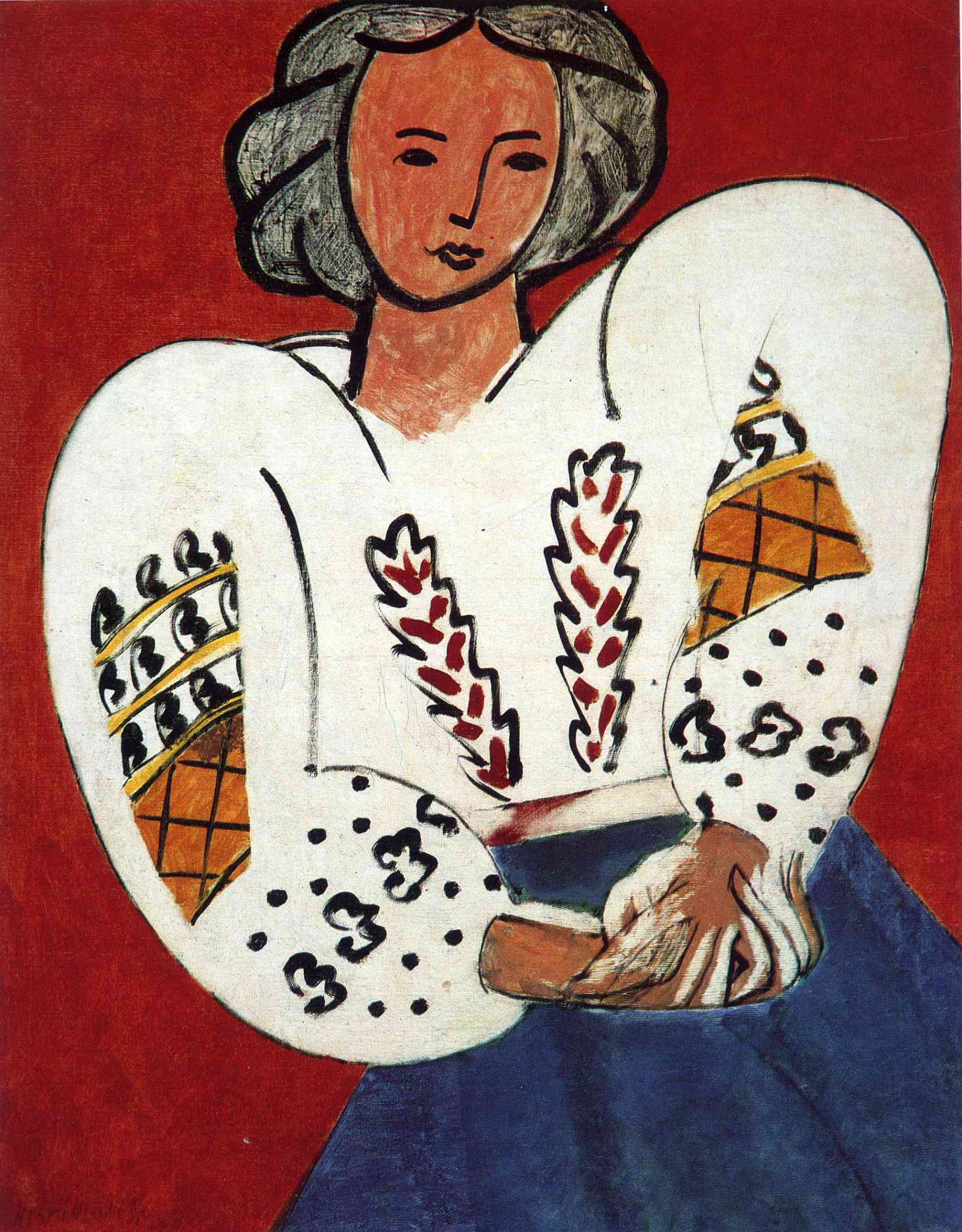
Henri Matisse | Romanian blouse, 1940 | Centre Pompidou

The ornamental embroideries of the blouse are actually the main topic here, as the painter showed great interest in all types of fabrics.
Matisse was moved by the graphic beauty of motifs in craftsmanship that he collected.
He conveys his exaltation, smoothing out details, streamlining lines and creating colour blocks, as the stylisation of the oak leaves central ornaments suggests it.
The blouse billows out, becoming pictorial space as much as metaphor.
11 photographs show the various stages of creation for this portrait, gradually erasing the young girl to better emphasise the embroidered blouse. | Source: © Centre Pompidou, Musée national d’art moderne

Henri Matisse | Romanian blouse, 1940 | Centre Pompidou - Musée national d'art moderne

Read More

Henri Matisse | Romanian blouse, 1940 | Centre Pompidou

The ornamental embroideries of the blouse are actually the main topic here, as the painter showed great interest in all types of fabrics.
Matisse was moved by the graphic beauty of motifs in craftsmanship that he collected.
He conveys his exaltation, smoothing out details, streamlining lines and creating colour blocks, as the stylisation of the oak leaves central ornaments suggests it.
The blouse billows out, becoming pictorial space as much as metaphor.
11 photographs show the various stages of creation for this portrait, gradually erasing the young girl to better emphasise the embroidered blouse. | Source: © Centre Pompidou, Musée national d’art moderne

Henri Matisse | Romanian blouse, 1940 | Centre Pompidou - Musée national d'art moderne